Life is, and always has been, an expressive medium. I think humans became expressive in order to imitate what life had already expressed around them in the form of nature. This is why early art forms focus on natural figures, such as, plants, animals and humans themselves. However, as we have developed our forms of expression as humans, we have begun to devalue natural forms of expression in favor of human-made art.
Figure 1: Panel of cave art in France (Panel of the Unicorn at Lascoux)
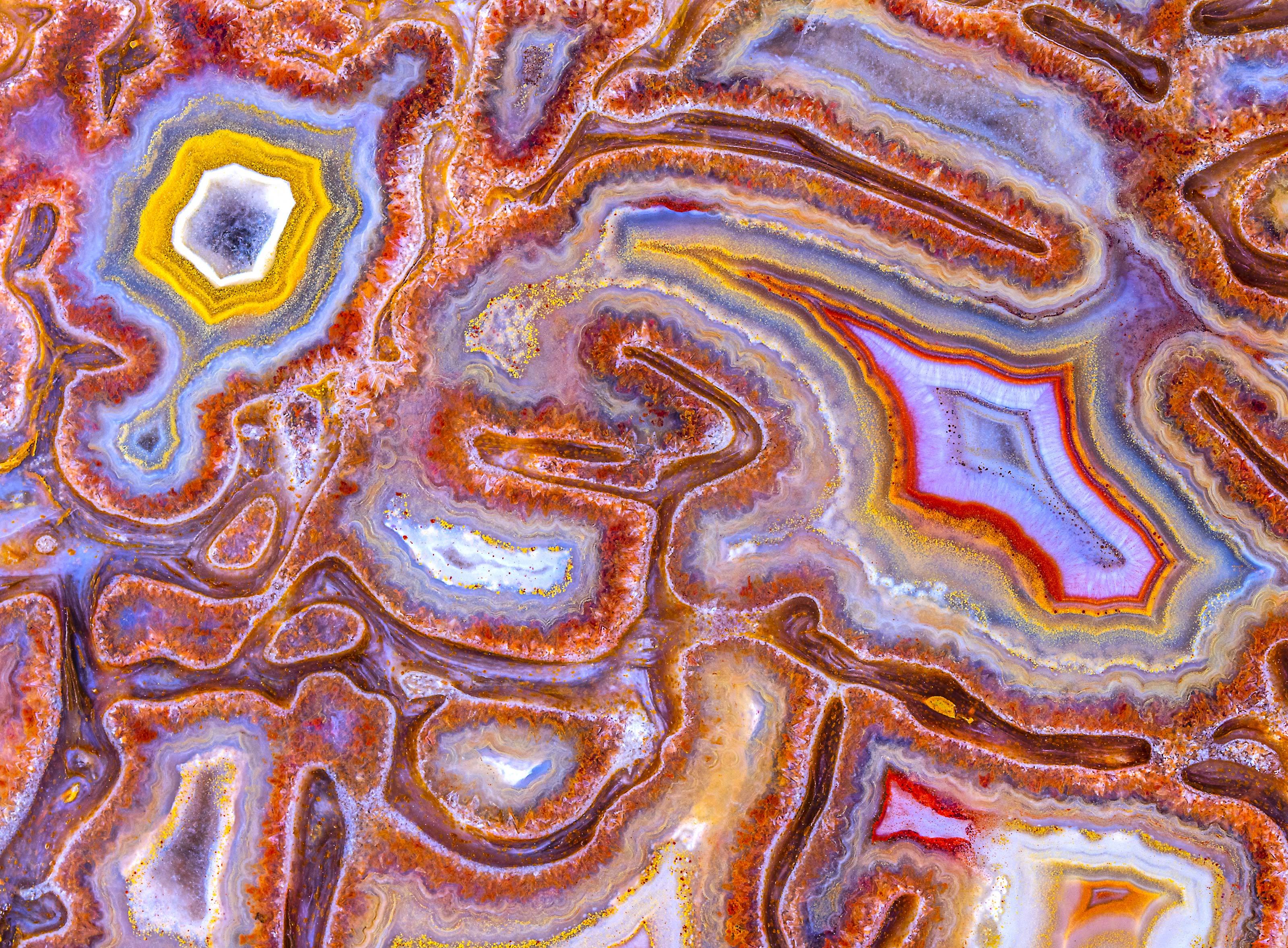
I personally do not think that sentience is a requirement for expression. When Robert Hooke peered into his telescope and discovered hundreds of thousands of living cells, he didn't just revolutionize biological science, he also revolutionized our understanding of forms of expression (Miranda). Using technology, such as the scanning electron microscope or even the simple light microscope, that is available today we can visibly see this expression with our own two eyes. Since Hooke's discovery of cells, we have also gone far enough as to be able to decode DNA and manipulate complex groups of genes, such as the Hox genes, to induce various mutations in offspring (Hox Gene).
Figure 2: image of agatized dinosaur bone taken with light microscope (Barker)
Therefore, the role of the artist in the biotechnology age is to use their art in a creative manner to further scientific discovery. For example, Joe Davies is an artist that has no formal scientific training who works at the Wyss Institute at Harvard. Even without the years of training, Davies's curiosities have furthered projects such as nuclear waste clean-up (Stulin). Ultimately, it is not up to us to police what tools bio-artists can and can't use. Whether or not we are comfortable with the idea, the tools that bioartists use are also being used by corporations in our food, water, and other household items. An experiment done in the 2010s showed how an ordinary McDonald's happy meal could last upwards of a year without little to no deterioration due to preservatives (McDonald's Food Experiment). As such, we are all bound to one another through the expressive nature of bio-art (Vesna and Ramakrishnan), whether we are sentient or non-sentient, aware or unaware, and happy or unhappy regarding the outcomes of biological manipulations.

Figure 3: McDonald's burger and fries after 243 days (Davies)
Works Cited
Barker, Norm. Agatized Dinosaur Bone. Baltimore, 2021.
Davies, Sally. “Day 137.” Sally Davies Photo, 25 Aug. 2010, https://www.sallydaviesphoto.com/gallery.html?gallery=Happy+Meal+Project&folio=Happy+Meal+Project. Accessed 6 May 2022.
“Hox Gene.” ScienceDirect, 2015, https://www.sciencedirect.com/topics/biochemistry-genetics-and-molecular-biology/hox-gene.
“McDonald's Food Experiment.” YouTube, 12 June 2007, https://www.youtube.com/watch?v=6us9kHHSNwk. Accessed 6 May 2022.
Miranda, Carolina A. “Weird Science: Biotechnology as Art Form.” ARTnews, Penske Media Corporation, 18 Mar. 2013, https://www.artnews.com/art-news/news/biotechnology-as-art-form-2184/.
Panel of the Unicorn at Lascaux. Ministère De La Culture, Saint-German-En-Laye, 2021, https://archeologie.culture.fr/lascaux/en/node/9028/salle-taureaux/paroi-gauche-panneau-licorne/licorne/info. Accessed 6 May 2022.
Stulin , Sam, director. Scientist? Artist. Pirate! Who Is Joe Davis? YouTube, NOVA, 10 Sept. 2015, https://www.youtube.com/watch?v=7GkZt00Qics. Accessed 6 May 2022.
Vesna, Victoria, and Siddharth Ramakrishnan. Hox Zodiac, 2022, http://hoxzodiac.com/wheel/animals.html.


Comments
Post a Comment