Week 4 : Medicine + Technology + Art
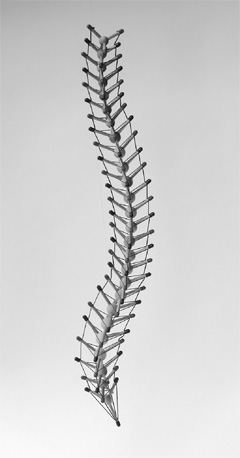
The material for this week's module on the intersection between medicine, technology, and art invoked two very different feelings for me. One of awe, in response to all of the different mechanisms in our bodies at a genetic, cellular, and physical that we have been able to figure out over centuries, and another of shock, at what we have used this information for. This week's topic is also one that is more personal for me, as I want to pursue a bioengineering masters and maybe become a doctor. Despite my previous knowledge and interest in the topic, I was surprised to learn about tensegrity as the potential mechanism for natural structural organization in living organisms (Ingber). I am fully in awe of this field of mechanobiology and the implications it might have in tissue and bone engineering.
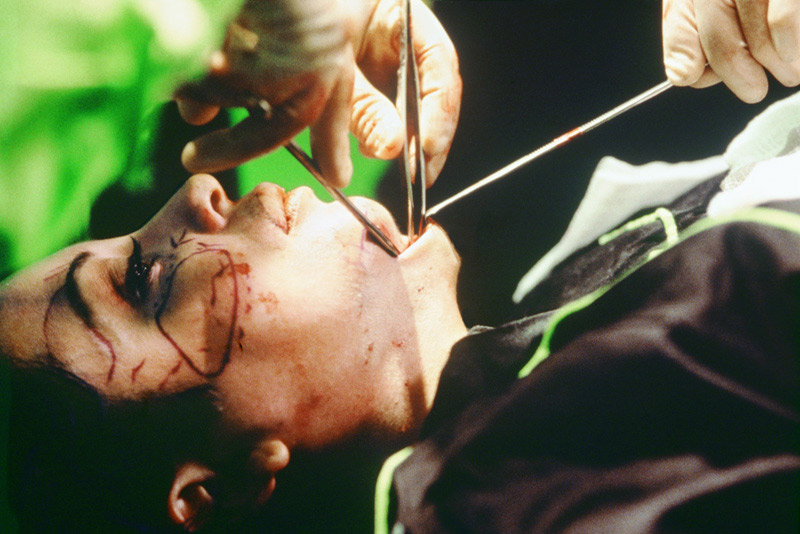
This is also applicable in the case of the french artist ORLAN, who elected to get cosmetic surgery as a part of some of her performances. Many people were outraged at this spectacle, and I was personally shocked at some of the the gory and intimate pictures of a procedure that few people regularly see on display in this manner. Supporters argued that this sort of performative surgery was a feminist act and a successful critique of traditional cosmetic surgeries, which tend to support unattainable beauty standards for women (Pescarmona). At first ORLAN's performance was shocking to me because it sacrificed a huge part of her personal identity (her face). However, it is technically no different of a choice than the one that people implanting microchips into their bodies or becoming test subjects for experimental procedures make. The more dangerous thing we should be worrying about is companies like Elon Musk's Neuralink beginning to push this technology to consumers (Dorisca), transforming the biohacking community from individuals who have made those decisions for themselves to a capitalistic system that doesn't care about the individual.
“The Birth of Plastic Surgery.” National Army Museum, https://www.nam.ac.uk/explore/birth-plastic-surgery.
Ceratti, Eric. “Reconstructive Surgery Before and After Photos.” Eric Ceratti, M.D. , 2022, https://www.drericcerrati.com/reconstructive-surgery-photo-gallery/. Accessed 22 Apr. 2022.
Dorisca, Samantha. “Elon Musk Will Reportedly Be Implanting Microchips into Humans as Early as This Year.” AfroTech, 6 Jan. 2022, https://afrotech.com/elon-musk-micro-chips-humans-neuralink.
Ingber, Donald E, et al. “Tensegrity, Cellular Biophysics, and the Mechanics of Living Systems.” Reports on Progress in Physics, vol. 77, no. 4, 2014, p. 046603., https://doi.org/10.1088/0034-4885/77/4/046603.
ORLAN. “Second Mouth, 7th Surgery-Performance Titled Omnipresence.” ORLAN, 21 Nov. 1993, http://www.orlan.eu/wp-content/gallery/operation-omnipresence-1993/derniere-orlan-1-72dpi.jpg. Accessed 22 Apr. 2022.
Pescarmona, Denee. “The Performances/Surgeries.” English 114EM: Women Writers, 1650-1760, University of California, Santa Barbara, 2003, http://oldsite.english.ucsb.edu/faculty/ecook/courses/eng114em/surgeries.htm.
SunSpiral, Vytas. “Tom Flemon’s Tensegrity Model of the Spine.” Being Human, 27 Apr. 2010, https://www.magicalrobot.org/BeingHuman/2010/04/introduction-to-biotensegrity. Accessed 22 Apr. 2022.
Tyson, Peter. “The Hippocratic Oath Today.” PBS, Public Broadcasting Service, 27 Mar. 2001, https://www.pbs.org/wgbh/nova/article/hippocratic-oath-today/.
You wrote a great discussion of the subject. I also find it relatable since I'm from South Korea where plastic surgery for cosmetic purposes is common. I think it is a very delicate matter to talk about our preferences and decisions because those are deeply intertwined with what happens around us and we usually justify what we do post hoc with or without sound reasons.
ReplyDeleteHi Selin, I really enjoyed reading your post about technology, medicine, and art. I admire your passion in bioengineering and becoming a doctor. I also wrote about plastic surgery as it a great way to tie technology/medicine into art. It is becoming more common in our society to have plastic surgery for cosmetic purposes.
ReplyDelete